General Chronology of the Development of Major Ignition Systems for Muzzle-Loading Firearms
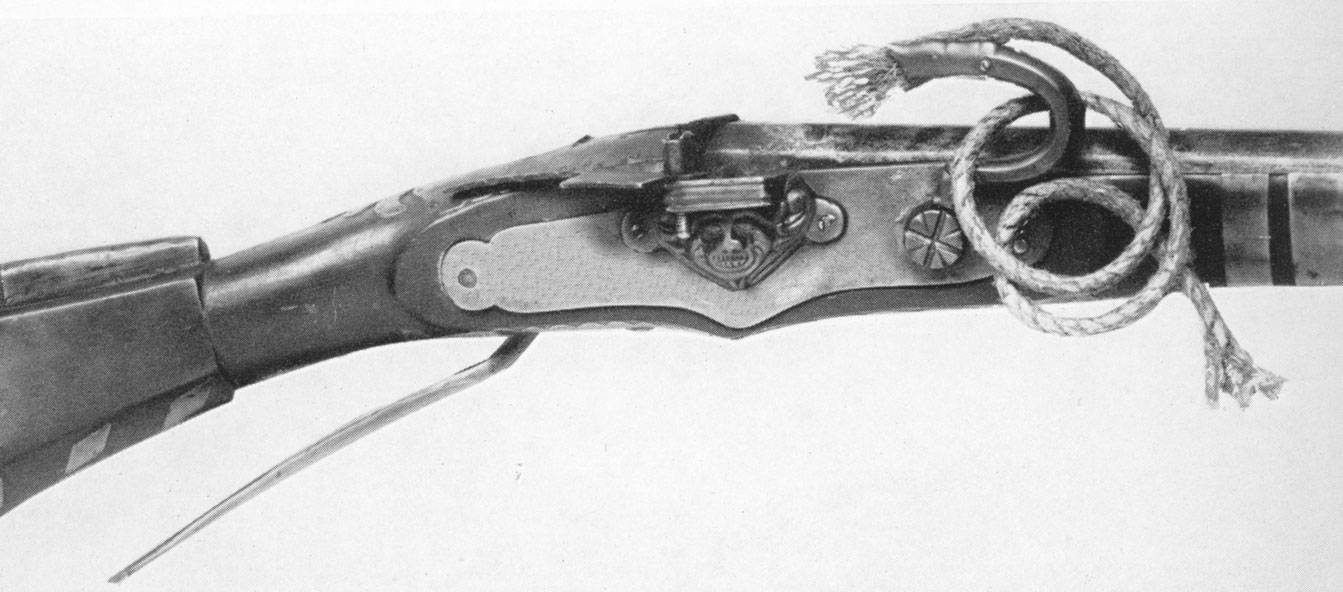
Matchlock - A priming charge is loaded into a flashpan with a separate, manually-operated cover. To fire, the cover is opened and then a slowly smouldering wick, held in the nose of the curved arm, is lowered by means of a lever (precursor to a trigger) to ignite a priming charge which then ignites the main propellant charge inside the barrel.
Matchlock above, with flashpan cover closed and with match in raised position.
This Japanese example below would have been built sometime between introduction of the technology by the Portugese in 1543, through the period when borders were closed to foreigners and technology became locked in static time until 1854 when Commodore Perry arrived exposing the islands to the outside world.

Wheellock - A steel wheel is wound up a partial turn against a spring and set with a catch. An arm, holding a flint, is manually lowered to the edge of the wheel. Upon the pull of a trigger, the wheel revolves smartly, producing sparks which ignite the main propellant charge.
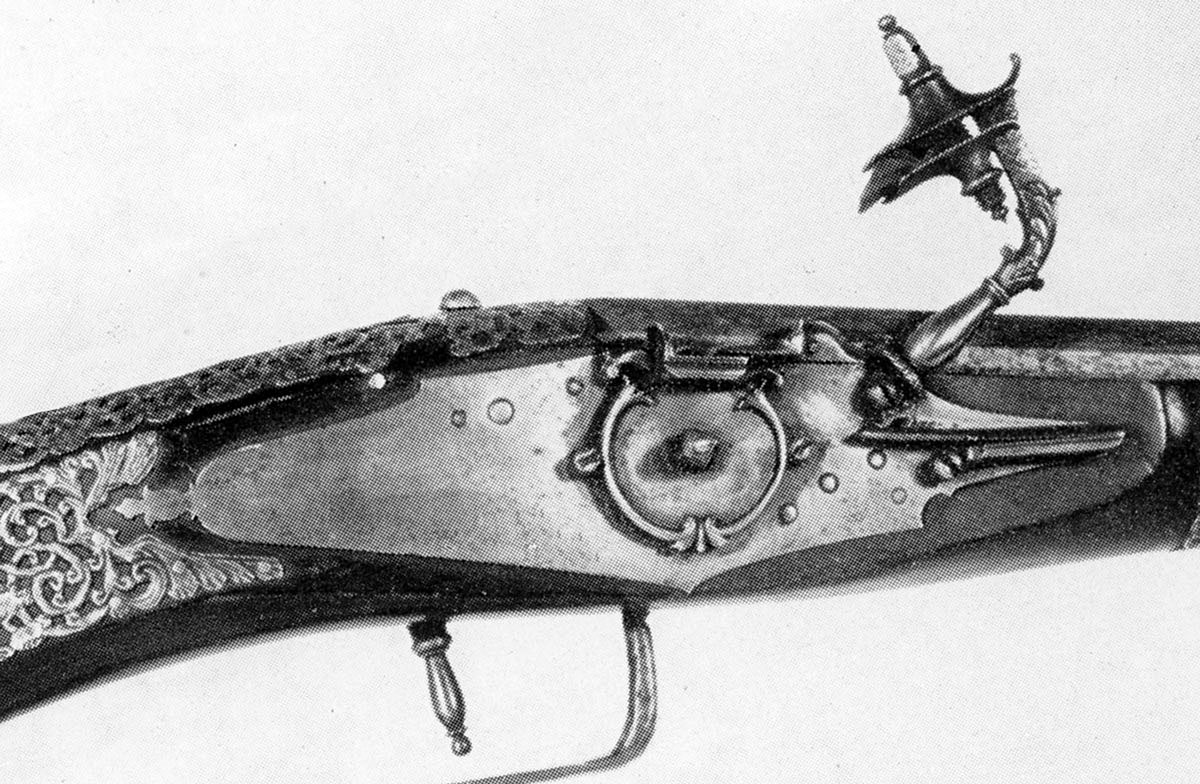
A Wheellock action above, with flint arm in safe position.
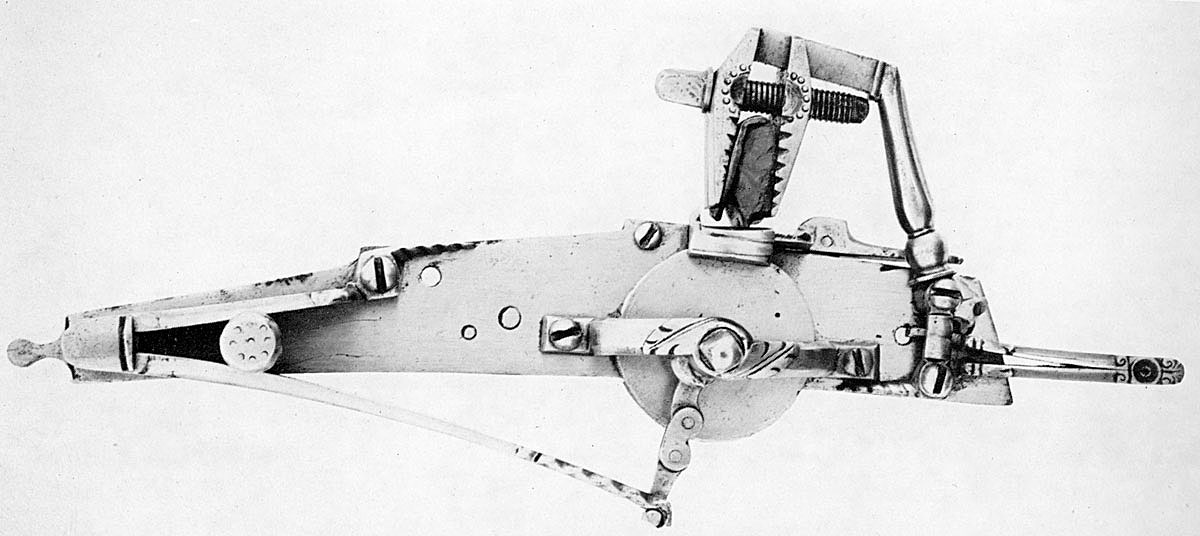
A Wheellock action above; the flint arm in the firing position; the wheel in the unwound position.
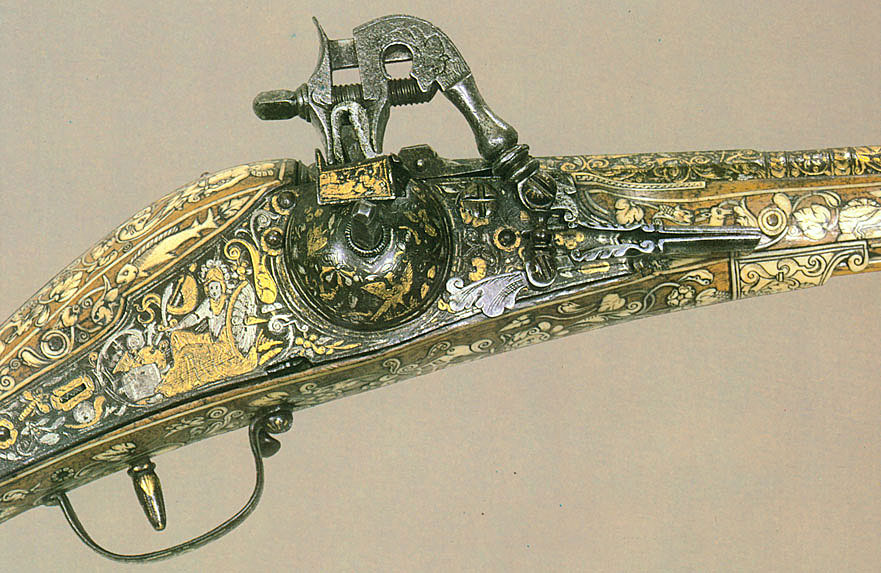
A nacent technology, wheellock guns were complex to build in an era with no machine tools. They appealed therefore only to the wealthy who could afford them in the first place and then who, generally, expected them to be highly decorated, deluxe examples of the armourer's craft as in the example below.
Snaphance - A spring-loaded lock whereby upon pulling a trigger, a hammer holding a flint falls, striking a steel frizzen and while pushing it forward scrapes particles from its surface, which as sparks, fall into a flashpan containing a priming charge of fine gunpowder, igniting first it and then, through a touchole, the main propellant charge. A separate pan-cover would allow the gun to be carried loaded, but for safety, not cocked.
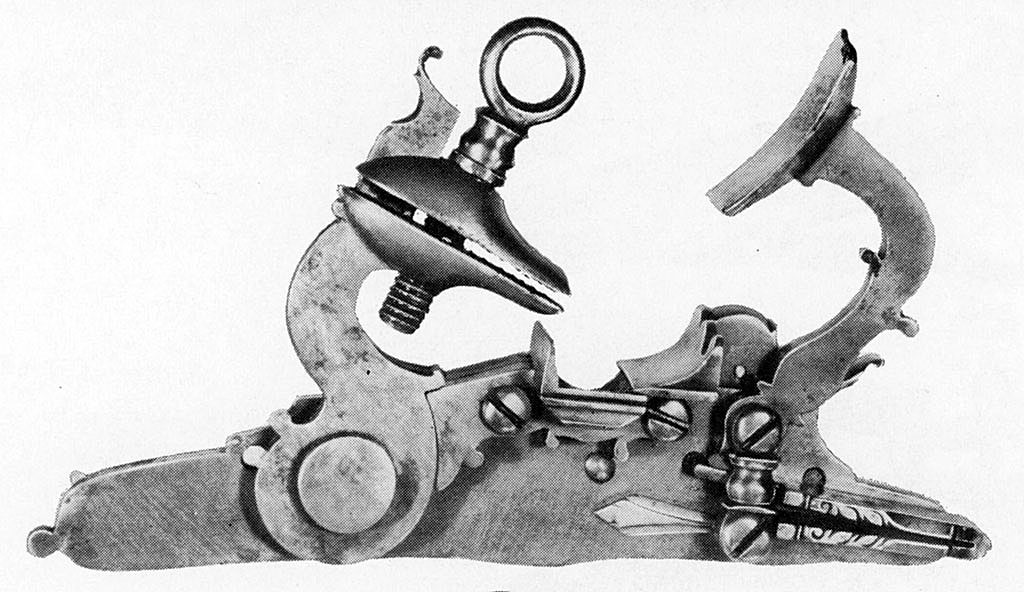
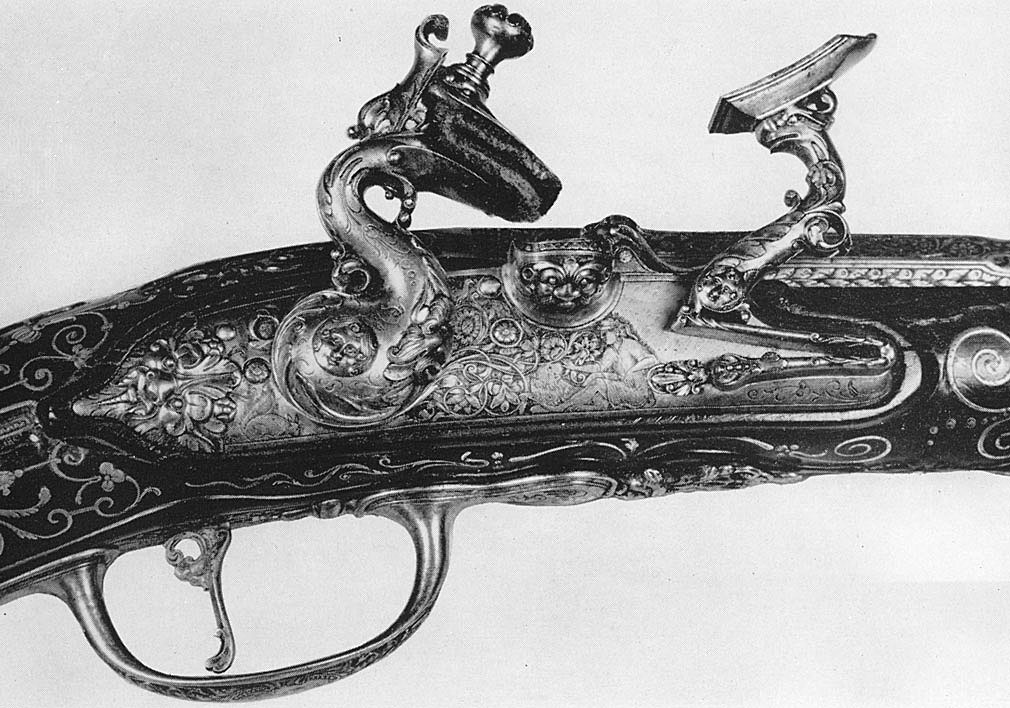
Flintlock - By convention, A Snaphance whose frizzen incorporates an integral flash-pan cover that lifts away as the hammer scrapes against the frizzen. A flintlock is therefore faster to operate and more reliable in wind and rain than a Snaphance. But, if loaded, it must be carried cocked. So, some kind of safety catch was called for.
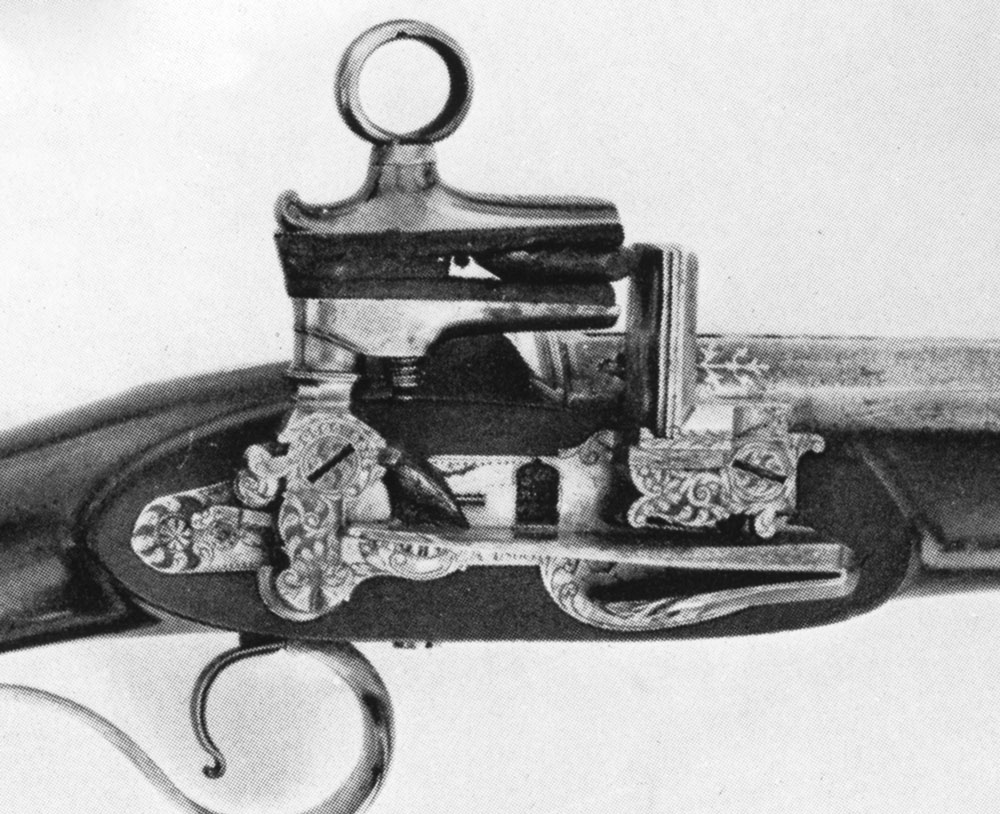
Early Flintlock, below---the Miquelet in the cocked position.
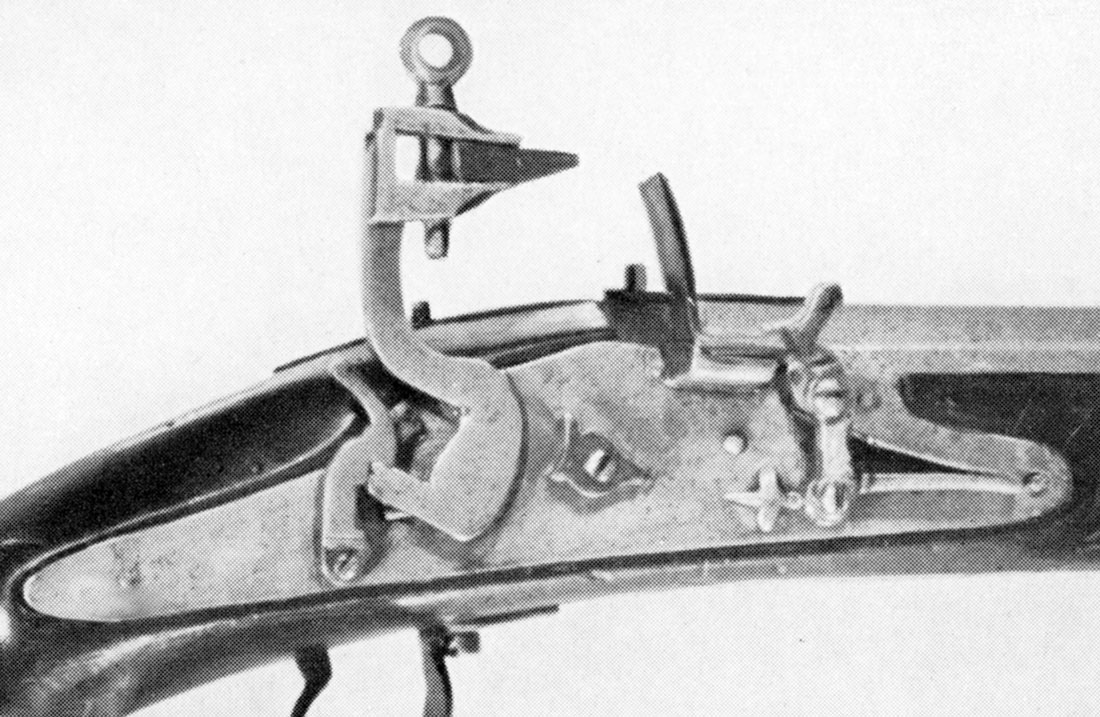
Another early flintlock, below---the Dog Lock. Note the manual "dog" catch, retaining the hammer safely in the cocked position.
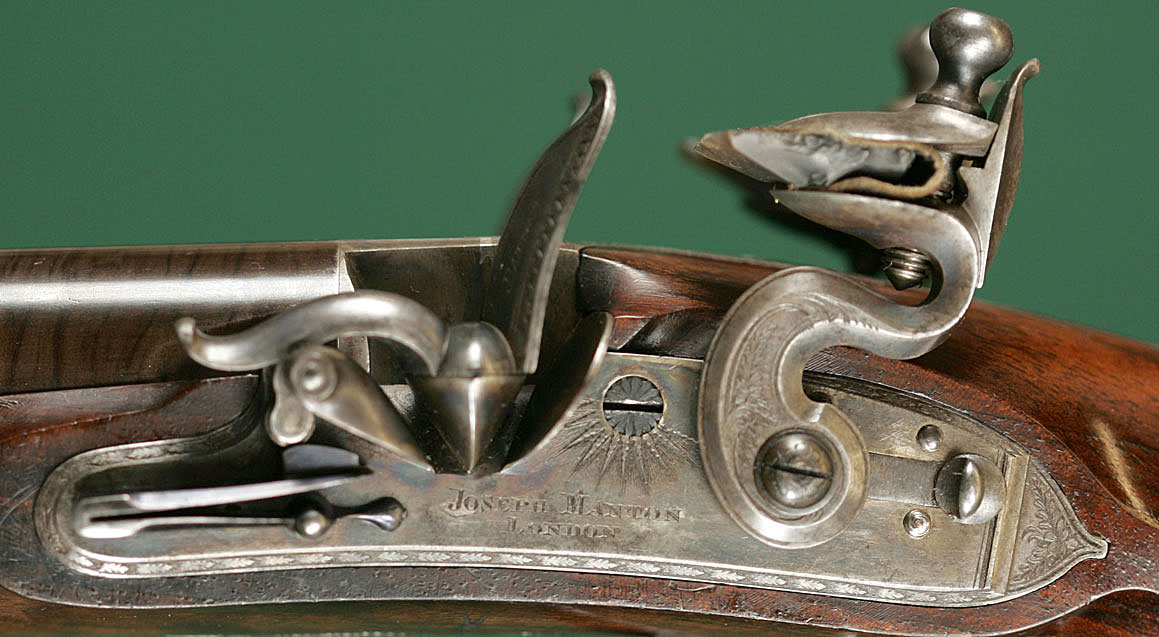
Final development of the Flintlock action above built in 1811, with rainproof flashpan loaded, roller-bearing frizzen-pancover closed, hammer cocked and safety engaged.
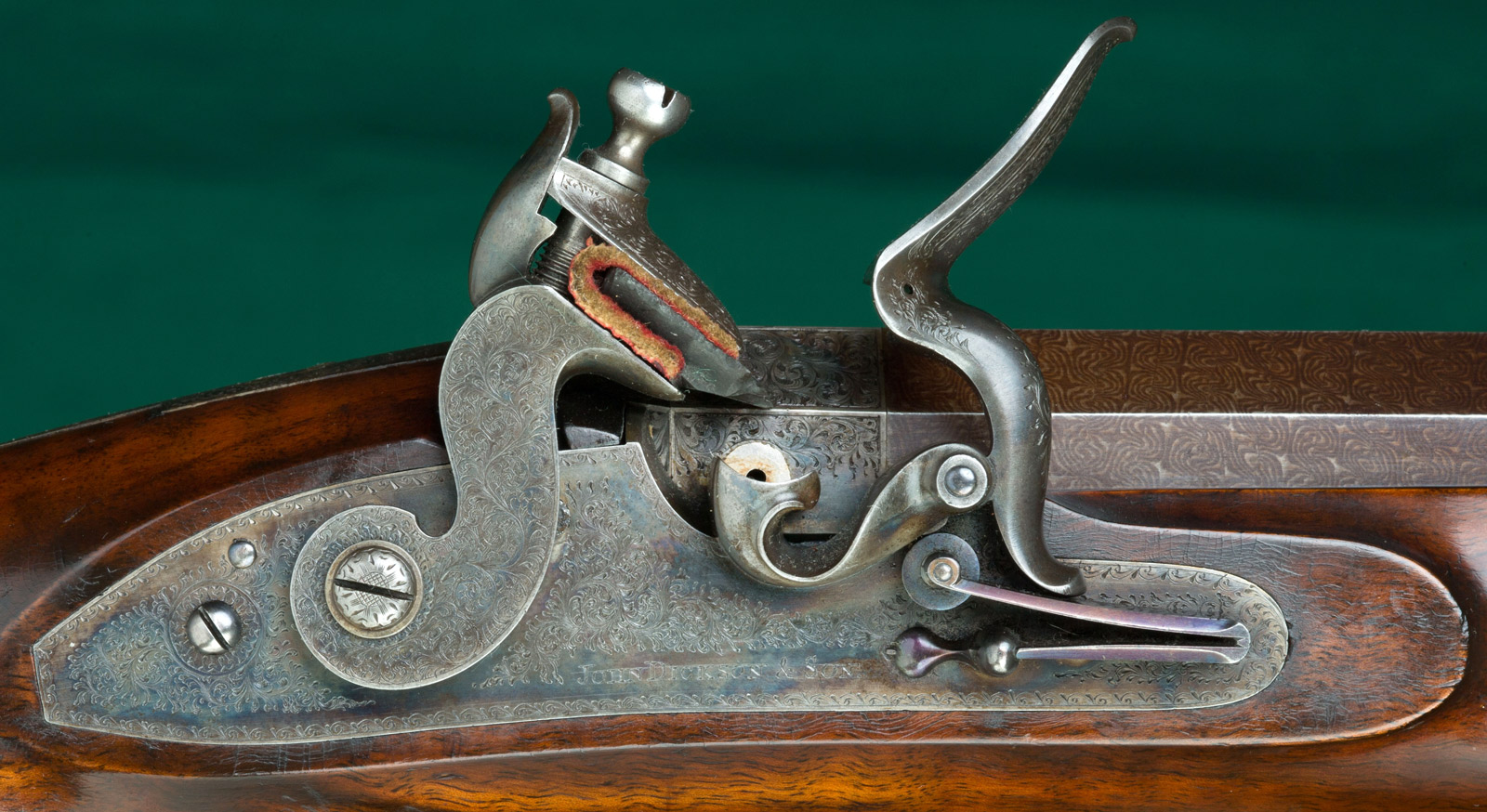
Another late Flintlock action above, with platinum touchole, in the fired position; the falling hammer having forced the frizzen-pancover forward. (This one built in 1893.)
Percussion - After the hammer is cocked, a small, cup-shaped cap, containing a bit of impact-sensitive fulminate, is placed upside-down on the tubular-conical nipple. To fire the gun, one pulls the trigger, releasing the spring-loaded hammer which falls on the head of the percussion cap, detonating the fulminate, sending fire through the hole in the nipple to the main charge inside the breech (having been loaded from the muzzle) touching it off and discharging the weapon.
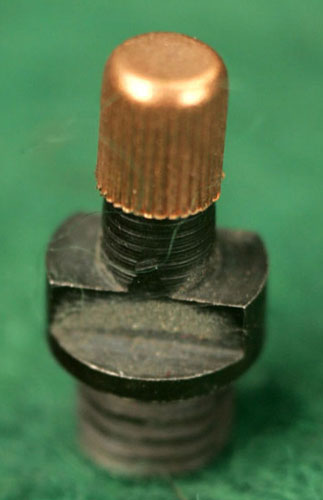
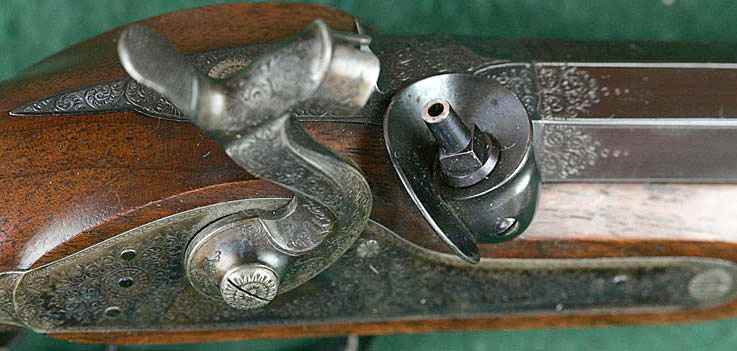
Percussion nipple with primer cap fitted. Percussion lock, cocked, awaiting fitting of the percussion cap.
The Hallowell & Co. Illustrated Firearms Dictionary is for informational purposes only. We do not necessarily offer the items described above for sale. Please click on any of the links below to see what we actually do have available for purchase.
American Shotguns English Shotguns European Shotguns Double Rifles Magazine Rifles Single Shot Rifles Combination Guns
Winchester Colt Smith & Wesson Other Handguns Antique Guns New Arrivals Custom Knives Other Neat Stuff
Who We Are How to Order We want to buy your Gun(s) Recommended Links Historical Gallery
Firearms Definitions, Abbreviations & Opinions Store Photos Magazine Articles Home
Hallowell & Co., Inc. PO Box 1445. Livingston, Montana 59047 USA Tel: 406 222-4770 Fax: 406 222-4792 Email: morris@hallowellco.com
Hours: Tuesday - Saturday, 10 - 6. (Mountain Time) Our inventory is constantly changing. Please bookmark this site and return often.