Rifling
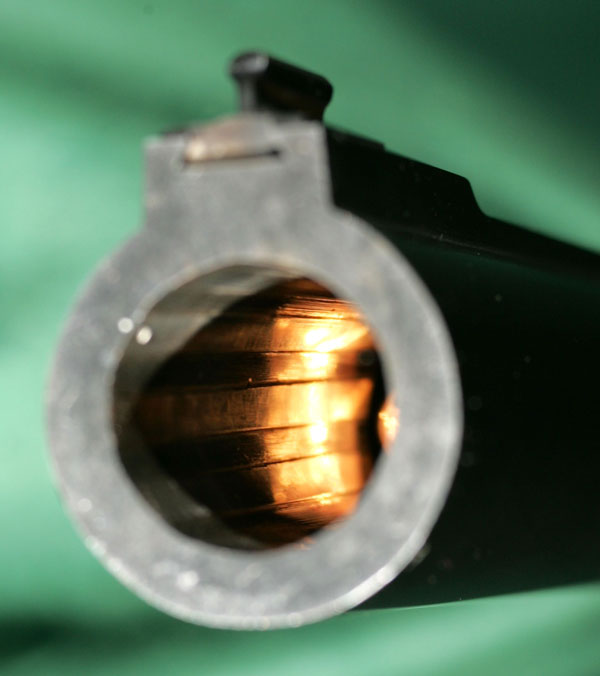
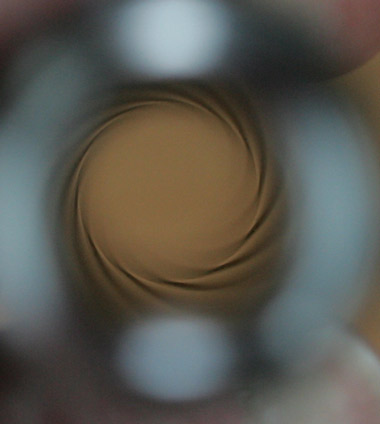
Photograph of Rifling --- spiral grooves cut in or forged into the bore of the barrel that impart a rapid spin to the single projectile, gyroscopically stabilizing it in flight for greatly improved accuracy over that of a smoothbore gun.
To make a rifled barrel, normally a hole is deep-drilled in a steel bar. Then, grooves are cut, leaving the original hole's surface as remaining lands. The bore size is measured land to land.
Cross-sectional drawings of different rifling patterns (from, H T Fremantle, The Book of the Rifle, Longmans Green & Co., London, 1901). In general chronological order:
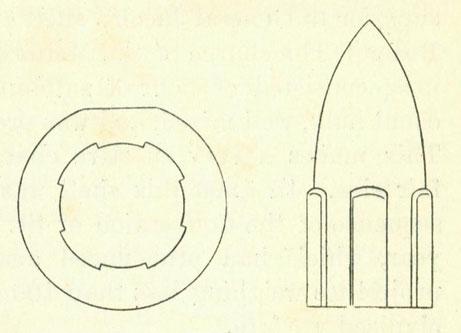 Jacob rifling, left. And its
required counterpart, the Jacob mechanical bullet, right.
Jacob rifling, left. And its
required counterpart, the Jacob mechanical bullet, right.
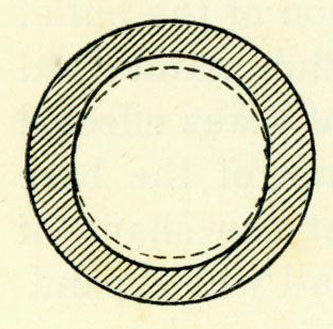 Lancaster Oval-Bore. No
obviously visible rifling. Rather, an oval-shaped bore cross-section that
spirals as it proceeds down the barrel.
Lancaster Oval-Bore. No
obviously visible rifling. Rather, an oval-shaped bore cross-section that
spirals as it proceeds down the barrel.
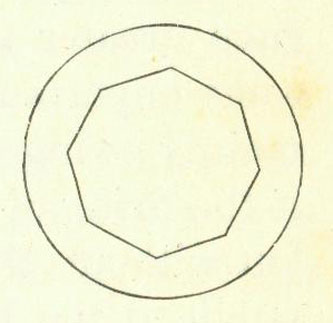 Whitworth rifling. As with
Jacob rifling, it required a specific-shaped (in this case octagonal) bullet.
Whitworth rifling. As with
Jacob rifling, it required a specific-shaped (in this case octagonal) bullet.
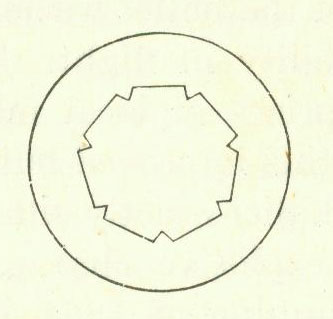 Henry rifling. Because of the
small triangular projections, a far more easily manufactured and loaded cylindrical
bullet could be used. Patented 1860 by Alexander Henry, Edinburgh Scotland.
Henry rifling. Because of the
small triangular projections, a far more easily manufactured and loaded cylindrical
bullet could be used. Patented 1860 by Alexander Henry, Edinburgh Scotland.
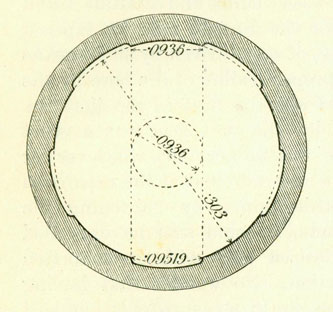 Metford / Enfield
rifling with equally spaced lands and grooves. By far the most common pattern in
use today. The number of lands and grooves may vary according to the opinion of
each barrelmaker.
Metford / Enfield
rifling with equally spaced lands and grooves. By far the most common pattern in
use today. The number of lands and grooves may vary according to the opinion of
each barrelmaker.
The degree of spiral is referred to as the rate of Twist, expressed in the number of inches required to accomplish one full turn. 1:10 means one full turn in ten inches. Generally, the longer the bullet in relation to its diameter, the higher the rate of twist is indicated. The long, slender 6.5x54MS bullet might stabilize best at a fast 1:8 rate of twist. The short, fat .505 Gibbs bullet might stabilize best at a slow 1:16 rate of twist.
Methods of producing rifling in a smooth-drilled barrel blank:
Hook Rifling - A single-toothed tool is repeatedly pulled through the bore in a spiraling twist, cutting one groove at a time to a slightly greater depth with each pass. It is then incremented to the next groove, the process repeated until all grooves are cut to the required depth.
Broaching – Similar to hook rifling, but with a succession of multiple-toothed tools in which all grooves are cut simultaneously to a greater depth with the passage of each incrementally larger cutter.
Button rifling – A multi-headed tool of extremely hard steel or tungsten carbide is either pushed or pulled through the bore, in one pass, forge-pressing grooves by displacing the barrel steel rather than removing it.
Hammer Forging – Using heavy specialist machinery, a slightly oversized barrel blank is hammered-swaged externally over a pre-contoured mandrel having the desired spiral lands and grooves, and sometimes even the chamber, already machined in place.
Rifle - A relatively long-barreled firearm, fired from the shoulder, having a series of spiral grooves (rifling) cut in or forged into the bore of the barrel that impart a rapid spin to the single projectile, gyroscopically stabilizing it in flight for greatly improved accuracy over that of a smoothbore gun.
If a putative shotgun is fitted with a rifled barrel intended for slugs (readily available for most production-made repeating shotguns), it is a rifle.
The Hallowell & Co. Illustrated Firearms Dictionary is for informational purposes only. We do not necessarily offer the items described above for sale. Please click on any of the links below to see what we actually do have available for purchase.
American Shotguns English Shotguns European Shotguns Double Rifles Magazine Rifles Single Shot Rifles Combination Guns
Winchester Colt Smith & Wesson Other Handguns Antique Guns New Arrivals Custom Knives Other Neat Stuff
Who We Are How to Order We want to buy your Gun(s) Recommended Links Historical Gallery
Firearms Definitions, Abbreviations & Opinions Store Photos Magazine Articles Home
Hallowell & Co., Inc. PO Box 1445. Livingston, Montana 59047 USA Tel: 406 222-4770 Fax: 406 222-4792 Email: morris@hallowellco.com
Hours: Tuesday - Saturday, 10 - 6. (Mountain Time) Our inventory is constantly changing. Please bookmark this site and return often.